
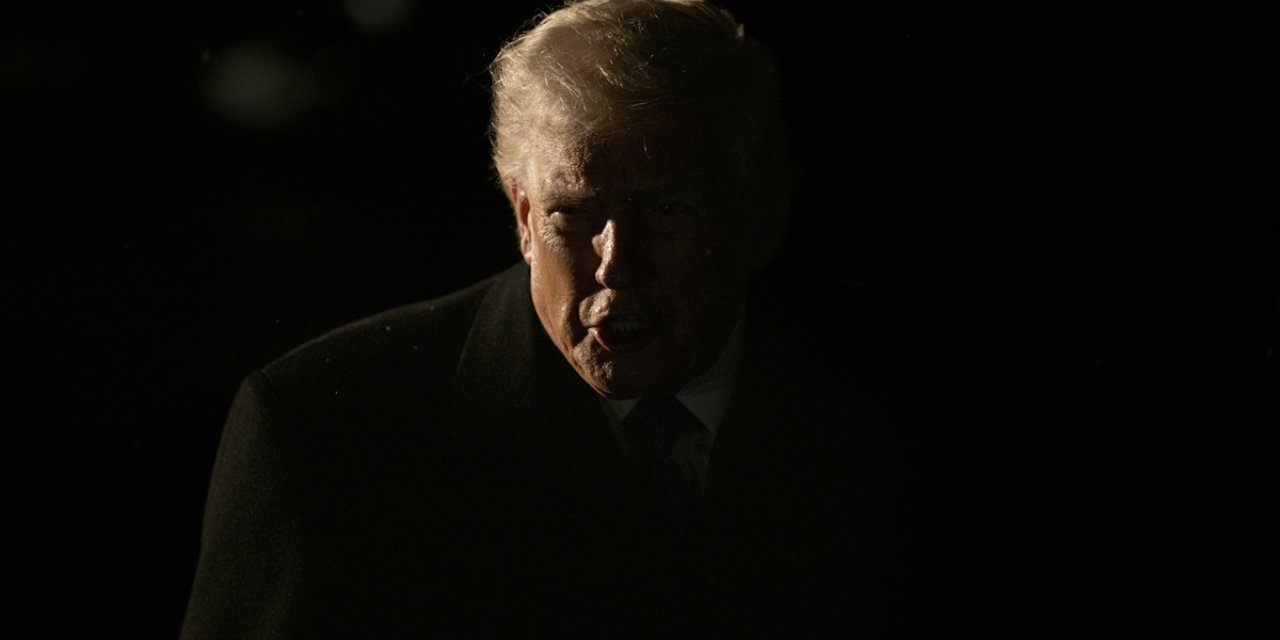
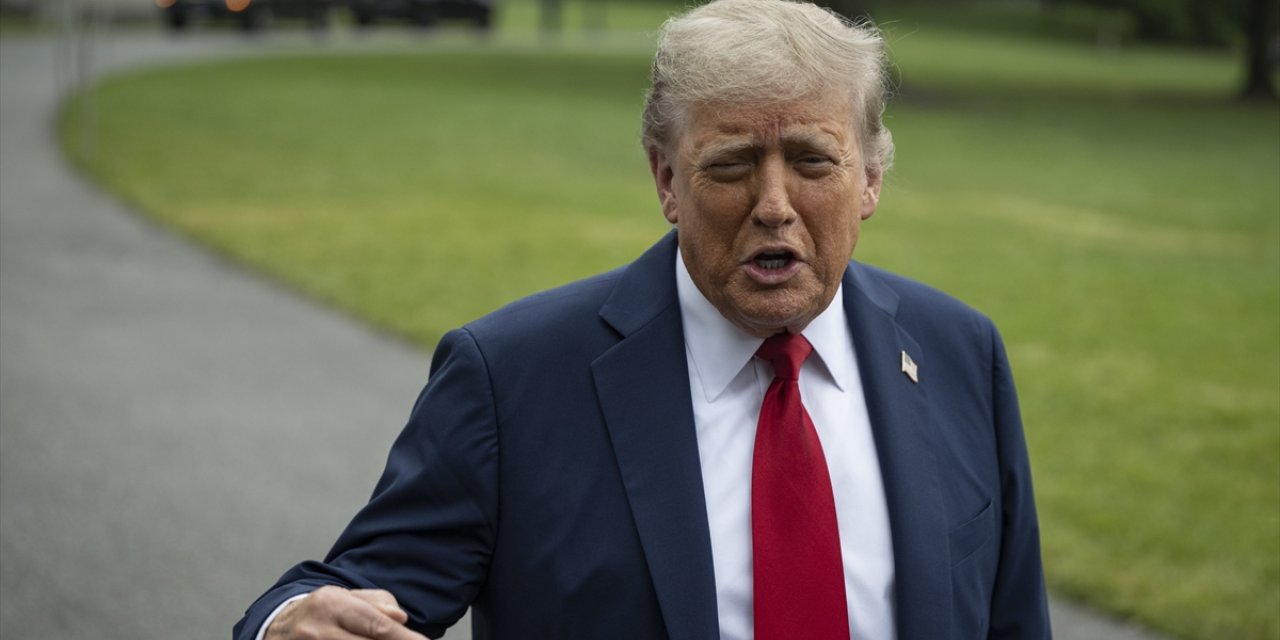
Trump’s first year back: ‘Unfiltered’ 2nd term reshapes global order, domestic policies
Analysts argue removal of traditional Republican restraints has unleashed a ‘sharper’ agenda compared to a ‘mild’ first term- Foreign policy shifts toward 19th-century ‘Manifest Destiny’ with a renewed Monroe Doctrine- Domestic focus centers on an ‘all-of-government’ immigration crackdown, driven by large number of executive orders
By Yasin Gungor
ISTANBUL (AA) – When Donald Trump first entered the Oval Office in 2017, the West Wing was often described as a battlefield of ideologies, where establishment Republicans sought to moderate the president’s impulses.
One year into his second term, that battlefield has fallen silent. The result is a presidency that has stripped away the "mild" veneer of the past, revealing what experts describe as the "real" Donald Trump.
From Venezuela to Greenland, and across the heavily surveilled interior of the US, the first anniversary of Trump’s second term marks the emergence of an "unfiltered" agenda that is reshaping both American governance and the global order.
The evolution is measurable. By the end of his first year back in the White House, Trump signed 228 executive orders, nearly quadrupling the 58 issued during the same period in 2017 and surpassing the 220 orders signed during his entire first four-year term. The figure underscores a shift from rhetorical disruption to rapid institutional engineering.
Charles Kupchan, a senior fellow at the Council on Foreign Relations and a professor at Georgetown University, described the 2017-2021 period as a "very mild version" of what the world is witnessing today.
"Trump pronounced 'America First' at the beginning of his first term ... but a lot of Trump's instincts were moderated and mellowed by the traditional Republican internationalists that surrounded him," Kupchan told Anadolu.
Kupchan noted that all “traditional Republicans” in Trump 2.0 “been fired,” adding: "We're seeing the real Donald Trump unfiltered by Republican hawks."
The result, he argued, is a form of governance that is "much sharper," with ideological overtones that are "much more pronounced."
Preparation has been central to this efficiency. Unlike the chaotic 2016 transition, the administration used its four years out of power to plan its return.
Colleen Putzel-Kavanaugh, an associate policy analyst at the Migration Policy Institute (MPI), said the administration benefited from "hindsight."
"His team had time to research, prepare, come up with ideas," Putzel-Kavanaugh told Anadolu.
This, she said, “allowed this administration to come in with ... momentum sort of queued up ... to start right away with very rapid-fire changes."
The political mandate has also shifted. Kupchan said Trump’s reelection and sustained popularity among his base have "redeemed Trump's instincts," reinforcing his belief that "he was right all along" to ignore the establishment.
- Foreign policy: The return of Manifest Destiny
This newfound efficiency has enabled a dramatic shift in global strategy. Moving beyond "America First" rhetoric, the White House has operationalized a spheres-of-influence approach, codified as the "Trump Corollary" to the Monroe Doctrine.
“The national security strategy clearly reorients America's global strategy and identifies the Western Hemisphere as the top priority,” Kupchan said.
That shift materialized with a US military operation that resulted in the capture of Venezuelan President Nicolas Maduro and his wife in Caracas. At the same time, the administration has refused to rule out force over the annexation of Greenland and has threatened to "take back" control of the Panama Canal.
Kupchan said these actions signal a "neo-imperial" turn that introduces a fundamental contradiction in US foreign policy.
"You see in the second term a tension, a contradiction between a neo-isolationist Donald Trump ... and a neo-imperial Trump who is more inclined to lash out and assert US power," he said.
He likened Trump’s interest in acquiring Greenland and controlling the Panama Canal to "19th-century American grand strategy," specifically the doctrine of Manifest Destiny, which framed US territorial expansion as inevitable and justified.
While asserting dominance in the Western Hemisphere, the administration’s relationship with European allies has shifted toward a transactional security model. At the June 2025 NATO summit in The Hague, allies – excluding Spain – yielded to White House pressure, pledging to raise defense spending to 5% of GDP by 2035.
Despite the coercive approach, Kupchan suggested Trump is, in some respects, "behaving more positively toward the alliance" than during his first term.
"In term one, he was talking about withdrawing from NATO; in term two, he had a good NATO summit... He's not talking about withdrawing," he said, arguing that the alliance is adapting to new US demands.
On the economic front, trade policy has evolved from a bargaining tool into a weapon of geopolitical leverage, marking what Kupchan described as a "quite dramatic shift."
"It's in some ways an intensification of policies that we saw ... in the first term," he said, noting that while Trump began using tariffs years ago, he "has relied on them much more heavily in his second term."
- Domestic policy: 'All-of-government' approach
While foreign policy has expanded outward, the domestic agenda has focused on rigid internal control.
The Trump administration has moved toward a comprehensive campaign targeting ideologies it deems antithetical to national interests, including the termination of federal diversity, equity, and inclusion (DEI) programs and the rollback of gender protections.
At the center of the domestic agenda, however, is immigration.
Unlike the 2017 rollout, which was quickly stalled by court injunctions and logistical setbacks, the current strategy is powered by a heavily funded enforcement apparatus.
The administration has declared an "invasion" under the Immigration and Nationality Act, a move that unlocked emergency authorities and military resources.
"There's a rapid-fire change in immigration policy that's happening at a much greater rate," Putzel-Kavanaugh said.
MPI data shows that while Trump’s first term saw 472 total executive actions on immigration, more than 500 were logged in the first year of his second term alone.
This acceleration reflects what Putzel-Kavanaugh described as an "all-of-government approach."
"We're … seeing the Department of State, the IRS (Internal Revenue Service), and several other government institutions are sort of being pulled into this deportation effort," she said.
The crackdown has expanded beyond the border to the interior. The administration has prioritized all millions of unauthorized immigrants for removal, abandoning the earlier focus on violent offenders. To support this shift, the government is increasingly relying on sensitive databases and advanced technologies.
"There's been a proliferation of data sharing and of an increase in the technologies that are used by ICE agents," Putzel-Kavanaugh noted.
She said agencies such as the IRS and the Social Security Administration are seeing their data – “typically off-limits” – accessed for enforcement purposes. In the field, agents are equipped with iris scanners, facial recognition software, and license plate readers.
"So, what that means for privacy, how that could implicate US citizens ... begs a lot of questions," she warned.
Putzel-Kavanaugh also cited reports of labor shortages in several sectors, as workers fearing deportation fail to report to job sites.
"We may very quickly see those implications in other sectors of our economy that rely on immigrant labor, whether that be health care, technology, agriculture, food service," she said.
- Continuity or breakthrough?
As Trump’s first year back in office concludes, analysts are debating whether the changes represent continuity with past policies or a decisive break from Trump 1.0.
Kupchan said the answer lies somewhere in between. While the "rhetoric is sharper and more of a break point than the reality," he argued that the cumulative impact is transformative.
"When you read the National Security Strategy, you see a continuity of US policy in the Middle East, in Europe and in Asia, not a sharp break," Kupchan said, adding that the most significant divergence lies in domestic governance.
"The biggest difference between [term] 1 and 2 is the consistent overreach at home," he said.
Putzel-Kavanaugh agreed, saying that while many actions "mirror" those of the first term, the scale has marked a major shift.
Kaynak:
This news has been read 124 times in total





Türkçe karakter kullanılmayan ve büyük harflerle yazılmış yorumlar onaylanmamaktadır.